
30 U.S. MPG, or about 7.8 L/100 km, is a useful starting point for comparing gas mileage. It matches the combined rating of one front-wheel-drive compact SUV. An efficient compact sedan can do better, while a full-size 4WD pickup can use considerably more fuel. Compare vehicles that do the same job and use the same test cycle.
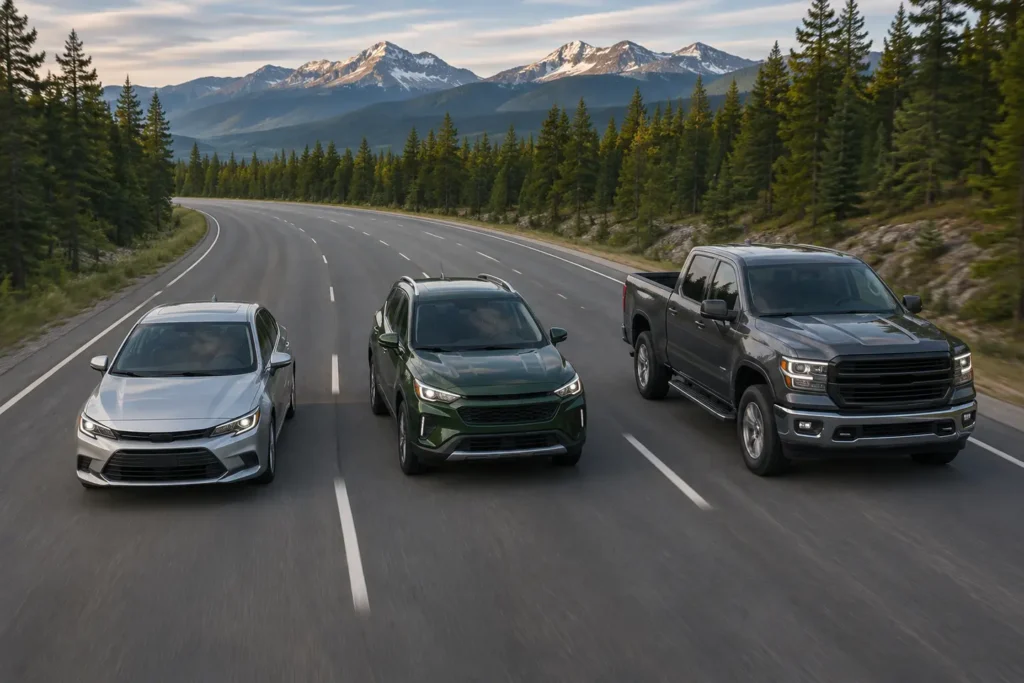
What counts as good mileage for a sedan, SUV or truck?
A useful benchmark is the combined rating for a comparable vehicle. Match the model year, engine and drivetrain when you can. The 2026 examples below show why 30 MPG can mean different things depending on what you drive.
| 2026 U.S. vehicle example | Combined U.S. MPG | Equivalent L/100 km |
|---|---|---|
| Toyota Corolla 2.0L gas, 1-mode transmission | 35 | 6.72 |
| Honda CR-V 1.5L gas, FWD | 30 | 7.84 |
| Ford F-150 2.7L gas, 4WD | 20 | 11.76 |
| Toyota Corolla Hybrid 1.8L, FWD | 50 | 4.70 |
The gas Corolla uses about 2.1 fewer U.S. gallons per 100 miles than the F-150 in these examples. That gap matters for your fuel bill, but the vehicles serve different purposes. If you need a pickup for towing or payload, compare it with other pickups configured for that work. For a smaller daily driver, compare compact sedans, hatchbacks or crossovers that meet your needs.
For broad U.S. context, the EPA’s 2025 Automotive Trends Report puts the estimated real-world average for new model-year 2024 vehicles at 27.2 MPG. That figure combines vehicle classes and powertrains. The EPA or Canadian label for a comparable vehicle gives you a closer benchmark for a specific purchase.
Is 25, 30 or 35 MPG good?
For a small gas car, 35 MPG is close to the efficient Corolla example. For a compact gas SUV, 30 MPG matches the CR-V example. A vehicle returning 25 MPG uses more fuel than either, and it still uses less than the 20 MPG 4WD pickup shown above. Compare combined ratings for a mixed commute and city or highway ratings when most of your miles fall into one category.
| U.S. MPG | Gallons per 12,000 mi | Annual fuel cost |
|---|---|---|
| 25 | 480 | $1,680 |
| 30 | 400 | $1,400 |
| 35 | 343 | $1,200 |
At those prices and that distance, improving from 25 to 30 MPG saves $280 a year. Improving from 30 to 35 MPG saves $200 a year. The same five-MPG improvement saves more fuel when you start at the lower MPG. To compare your own options, divide your annual miles by each vehicle’s MPG and multiply by the price per U.S. gallon.
What is good fuel economy in L/100 km?
In Canada, lower L/100 km means less fuel used. A rating around 7 to 8 L/100 km is in the range of the compact gas sedan and SUV examples above. For vehicles sold in Canada, look up the exact configuration in Natural Resources Canada’s fuel consumption ratings. The label gives you a local benchmark for that model and trim.
The metric calculation makes the trade-off easy to see. At 15,000 km a year and CAD $1.60 per litre, a car using 7.0 L/100 km costs CAD $1,680 a year in fuel. A vehicle using 9.0 L/100 km costs CAD $2,160. That is 300 more litres and CAD $480 more per year. To convert a U.S. MPG result to L/100 km, divide 235.21 by MPG. The MPG and L/100 km calculation guide covers U.S. and imperial gallons separately.
How to compare the rating with your own mileage
- Start with the right rating. Look up your model year, engine and drivetrain. Compare city, highway or combined figures with the kind of driving you do.
- Measure several fill-ups. Record distance and fuel used between full fills. Add the distance and fuel across the same period before calculating the result. That gives longer intervals the right weight.
- Compare similar conditions. Short winter trips, idling, towing and sustained highway speeds can change fuel use. Compare repeat trips or similar seasons when you want to see whether your mileage has changed.
If you are deciding whether to buy a hybrid, turn the two fuel economy ratings into annual dollar savings. Add the difference in purchase prices to see how long those savings could take to cover it.
Ratings and methodology
Vehicle ratings are U.S. EPA combined figures for the exact configurations shown. Fuel prices and driving distances in the cost examples are illustrative inputs. Use your local pump price and annual distance for a personal estimate.
- U.S. Department of Energy and EPA fuel economy listings for 2026 Toyota models, 2026 Honda CR-V models and the 2026 Ford F-150 4WD 2.7L.
- U.S. EPA Automotive Trends Report highlights for the 2024 model-year new-vehicle average.
- Natural Resources Canada guide to understanding fuel consumption ratings and vehicle rating search.
Pingback: How to Calculate MPG and L/100 km | Fuel Economy Guide